
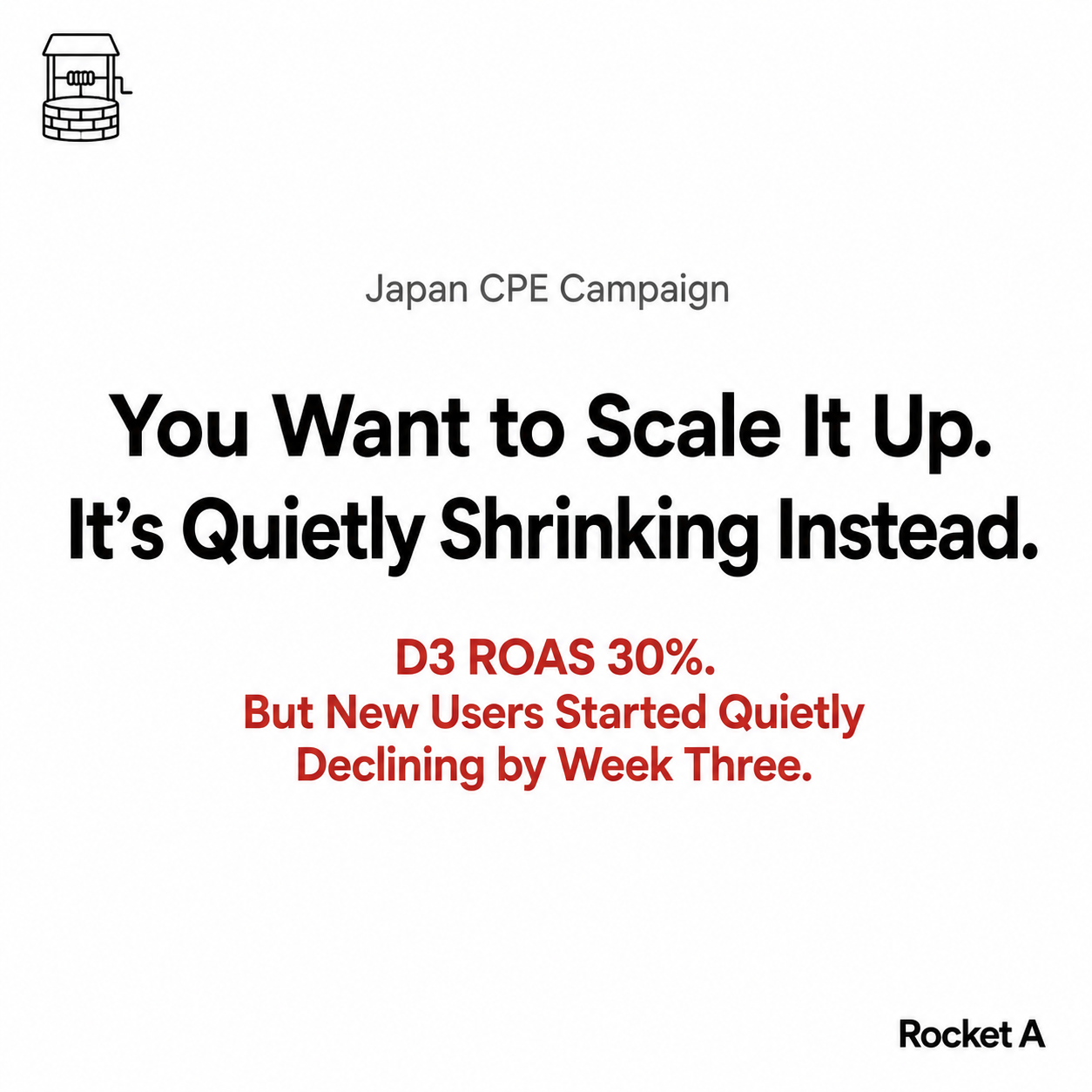

A CPE campaign in Japan hit D3 ROAS of 30% — well above the industry average. Retention held strong too.
Then, in week three, the water ran out.
The clearest spring runs dry first. This campaign was no exception.
The Tradeoff No One Puts on the Kickoff Slide
A reward event tuned for quality — the right reward tier, the right task difficulty, the right targeting — produces exactly the users it was designed to produce: fewer of them.
Reward-network data backs this up directly. As players move through successive reward tiers, the number who reach each next tier drops off exponentially — the harder or higher the bar, the smaller the group that clears it (Adscend Media, 2024). A campaign engineered for high-intent users isn’t leaking volume by accident. It’s spending volume to buy quality, on purpose.
The clearer the water, the shallower the spring. So “good campaign, limited scale” isn’t a contradiction. It’s the bill for the KPI you already hit.
Why This Hits Harder in Japan
Japan doesn’t reward volume plays. It’s the hardest APAC market to convert an impression into an install in the first place.
| Market | Install Conversion Difficulty | Note |
|---|---|---|
| Japan | Baseline (hardest in APAC) | Impressions convert to installs least easily of any APAC market |
| South Korea / Australia | ~3x easier than Japan | — |
| US / UK / Canada | ~4x easier than Japan | — |
Source: adjoe, “Guide: Advertising Mobile Games Across APAC,” 2025
Japanese advertisers already run a 3:1 paid-to-organic install ratio — read by adjoe not as inefficiency, but as evidence that concentrated, disciplined spend beats broad volume here.
Japan is a market built for a narrow, deep spring — not a wide, fast stream. A CPE campaign tuned tightly enough to hit its KPI is doing exactly what this market rewards. It’s also, by the same design, doing exactly what caps its own volume.
The Spring Doesn’t Need to Widen. It Needs to Refill.
The instinct, when the water runs low, is to dig the well wider until the flow picks up again. That’s the fastest way to muddy the water you’ve spent this long keeping clear.
The alternative isn’t lowering the bar. It’s opening a second channel to the same clean water.
| Tactic | What It Does | Why It Works |
|---|---|---|
| Multi-Tier Reward Design | Add a lower-barrier entry tier alongside the existing high-bar tier | Prevents the exponential drop-off between reward tiers |
| Media Diversification | Spread the same qualifying conditions across multiple placements or networks | Repeated exposure to one narrow pool hits diminishing returns |
| Event Refresh | Rotate creative and tasks instead of running one long-lived event | Avoids exhausting the segment of the audience that responds |
Sources: Adscend Media (2024); Nielsen / NC Solutions frequency research; Singular, “Creative Fatigue in 2025”
None of these tactics touch the quality bar that produced the KPI. They touch how many chances a qualifying user gets to reach it.
The Real Question Isn’t “Why Did the Water Run Low?”
It’s whether the plan to refill the spring was built alongside the KPI — or only after the water started looking thin.
A well-designed CPE event in Japan will always narrow its own spring. The campaigns that keep drawing water aren’t the ones that avoid this. They’re the ones that planned for it before day one.
Planning a CPE (Reward) campaign in Japan? Let’s design the spring to refill itself — before the KPI dries it out.
For more data and insights, explore our articles on rocket-a.com or follow our LinkedIn page. If you’re interested in running campaigns across Japan’s local media, we’d love to hear from you.