
Korea and Japan sit two hours apart by flight. Marketers routinely treat them as one region with one strategy.
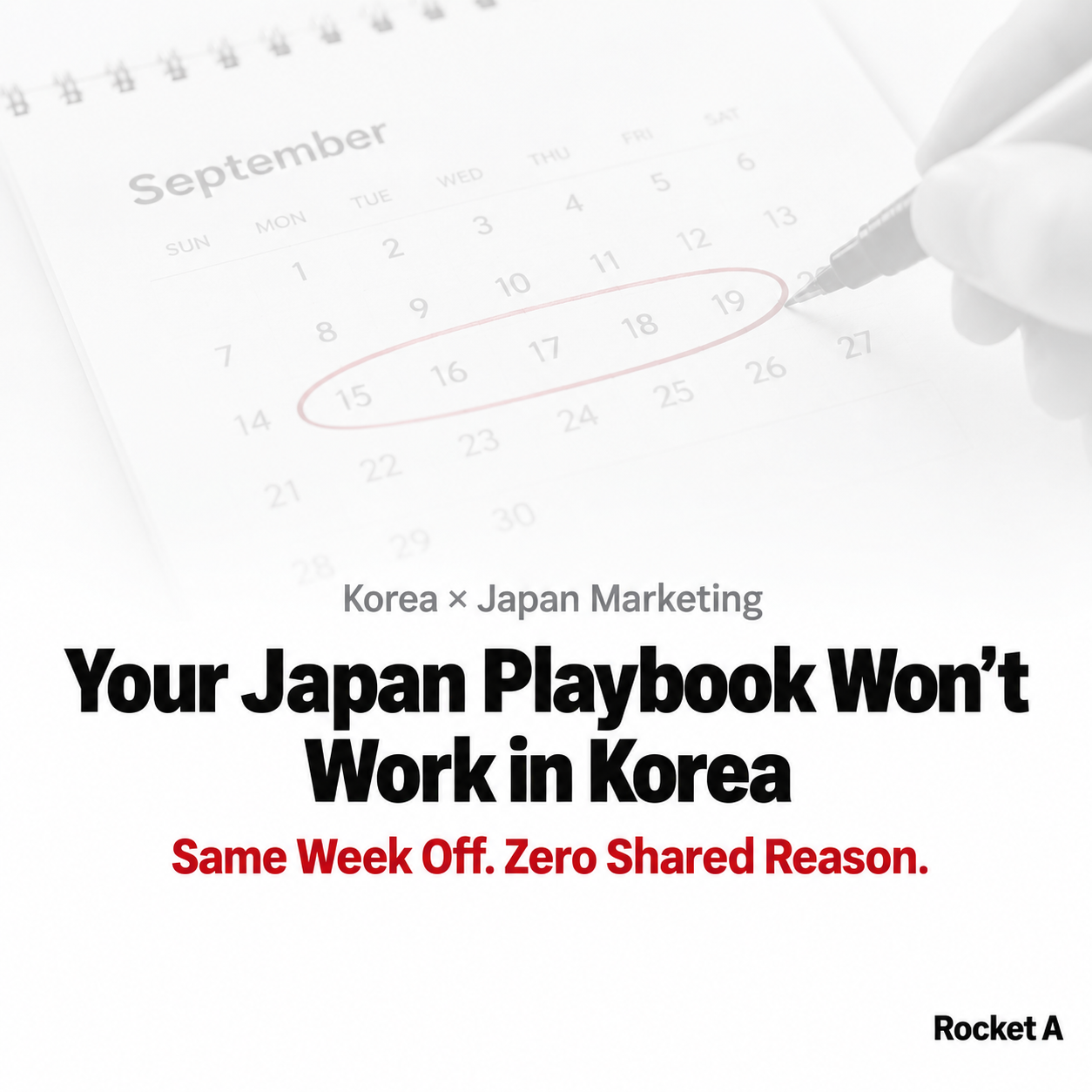
They aren’t, and it isn’t. In September 2026, Korea’s biggest holiday of the year, Chuseok (Sept 24–26), lands in the same week as Japan’s Silver Week (Sept 19–23) — the first overlap in eleven years. One is a 3,000-year-old harvest tradition built around ancestral rites and a nationwide trip home. The other is a handful of unrelated national holidays that happen to chain together into one long break, with no shared meaning behind it at all.
Same week off. Zero shared reason for it. That’s how different two of the “closest” markets in Asia can be — and the calendar is the easy example. The harder one is what these two markets don’t even agree to call the product you’re selling.
The Words Don’t Match Either
Anyone who has actually worked with both a Korean and a Japanese partner has probably noticed this: the two markets don’t use the same words for the same advertising concepts.
NCPI (Non-incentivized CPI) — Korea uses the English acronym as-is. Japan skips the acronym entirely and spells out the full meaning in katakana. One market compresses the term; the other unpacks it.
CPE (Cost Per Engagement) — In Korea, this is more commonly called “reward-type CPA” or “performance advertising.” Same product, but Korea’s name for it emphasizes results, while Japan’s emphasizes engagement.
SNS — Korea and Japan both say “SNS.” The English-speaking market the term came from barely uses it anymore, defaulting to “social media” instead. On this one, Korea and Japan actually resemble each other more than they resemble the market the phrase originated in.
None of this is a translation quirk. Each term is a fossil of how that market first made sense of the product.
| Term | Korea | Japan | English-Speaking Market |
|---|---|---|---|
| NCPI | Uses the acronym directly | Spelled out in katakana | Non-incentivized CPI |
| CPE | “Reward CPA” / performance ad | CPE (used as-is) | Cost Per Engagement |
| Social platforms | SNS | SNS | Social Media |
Where the Difference Actually Comes From
Japan — Japan’s CPE market grew out of soil shaped by decades of wage stagnation following the collapse of the bubble economy. According to Japan’s Ministry of Health, Labour and Welfare, if 1996 is indexed at 100, Japan’s nominal wage index in 2019 was 96 — essentially unchanged after 23 years. Over the same period, Germany reached 158, France 160, the US 232, and the UK 238.
It would be a stretch to say stagnant wages directly created Japan’s CPE industry. The more recent, faster growth of “poi-katsu” (point-collecting side hustles) is more directly tied to inflation in the 2020s and the spread of cashless payments after COVID. But the ground was already prepared: decades of flat wages built a culture where frugality was simply normal — and that’s the soil recent inflation landed on when it made poi-katsu take off so fast.
Korea — Korea took the opposite route. A short, install-only reward ad format first took off as a way to boost app store rankings. Now that same format is drifting toward the same destination Japan already reached: a small side income tool, Korea’s own version of “app-tech.” According to a survey by the 20’s Lab at Univ Tomorrow, among respondents who had engaged in money-saving or side-income activity in the past year, 69.8% cited “saving on living expenses” and 62.0% cited “earning extra income” as reasons for starting app-tech (multiple responses allowed).
Korea started from a ranking-boosting tool. Japan started from a frugality culture. Two completely different starting points — converging on the same place: a small, steady side income.
The Real Takeaway
The differences between the Asian, European, and North American markets were never just a matter of physical distance. They’re built from layers of social and economic background that took decades to form.
If you’re looking at the Korean or Japanese market, the advantage isn’t just securing ad inventory. It’s working with a partner who understands the cultural context those markets were shaped by — and can help you approach each one on its own terms. That’s the partner Rocket A tries to be.
Planning a campaign that accounts for the real differences between Korea and Japan — not just the ones on a map? We’d love to talk.
Interested in campaigns across Japan and Korea’s local media?